Your body is designed to be active. Nicholas A. Dinubile, MD says "If all the benefits of exercise could be packaged in a single pill, it would be the most prescribed medication in the world". I'm a personal trainer and I specialize in fitness over the age of 50. I would argue with anyone that a sedentary lifestyle is the leading cause of most of the aches and pains associated with aging.
I've seen first hand people of all ages who complain of back pain, shoulder pain, knee pain, and many other physical and mental aliments get better when they get up and start to exercise on a regular basis. I have a client in his 60s who had been getting steroid shots in his lower back for years recently tell me that he hasn't needed another shot since he started working out with me over two years ago. Click here to read the complete post

I'm an ACE certified personal trainer and National Masters Over 60 Powerlifting Champion with over 25 years of experience in the health and fitness industry. I've seen a lot of fads come and go, but three things remain constant in getting healthy and staying fit. A positive mental attitude, a healthy balanced diet, and a fitness program built on proper strength training and cardiovascular exercise. Practice these three things daily and you will discover that they lead to "The Fountain of Youth."
Showing posts with label benefits of exercise. Show all posts
Showing posts with label benefits of exercise. Show all posts
Monday, September 3, 2018


Friday, September 22, 2017
Over 40 Beginner's Strength Training Program
Whether you are 40 or 90 it’s never too late to begin strength training program People in their nineties can still build muscle and become stronger. My oldest client started working out at age 90. Here is a perfect strength training program to start building muscle and getting stronger.
In this strength training program, you will work all the major muscle in your body. This routine is designed for you to do every third day. For example do this program Monday, Thursday, and Sunday etc… Spacing out this routine is important to give your body a chance to recuperate between workout sessions. Strength training tears down muscle fibers, so your body needs the proper recovery time to rebuild those fibers stronger.
You should do each exercise for two sets of 10 repetitions with at least one minute but no more that two minutes between each set. For each exercise select a resistance with which the last three repetitions are difficult to complete. Do this routine for two months. Click here to see the entire post
In this strength training program, you will work all the major muscle in your body. This routine is designed for you to do every third day. For example do this program Monday, Thursday, and Sunday etc… Spacing out this routine is important to give your body a chance to recuperate between workout sessions. Strength training tears down muscle fibers, so your body needs the proper recovery time to rebuild those fibers stronger.
You should do each exercise for two sets of 10 repetitions with at least one minute but no more that two minutes between each set. For each exercise select a resistance with which the last three repetitions are difficult to complete. Do this routine for two months. Click here to see the entire post
Saturday, August 26, 2017
Why Strength Training Is so Important for Optimal Health, by Dr Joseph Mercola
Below is an excerpt from an article by Dr. Joseph Mercola,
osteopathic physician explaining the importance of strength training for
optimal health. This is one of the best articles I’ve read on the
benefits of weight lifting. It’s a must read.
Research confirms that exercise is the best “preventive drug” for many common ailments and chronic diseases, from psychiatric disorders and pain to heart disease, diabetes and cancer. As stated by Dr. Timothy Church, director of preventive medicine research at the Pennington Biomedical Research Center in Baton Rouge.
“Exercise strengthens the entire human machine — the heart, the brain, the blood vessels, the bones, the muscles. The most important thing you can do for your long-term health is lead an active life.”
Unfortunately, many make the mistake of focusing on cardiovascular exercise to the exclusion of everything else. Strength training is overlooked by many for a number of different reasons. Women may think they’ll bulk up and look manly, the elderly might worry about it being too strenuous or dangerous, and parents might think weight training is too risky for their children for these same reasons.
The truth is, nearly everyone, regardless of age or gender, will benefit from strength training. Working your muscles will help you shed excess fat, maintain healthy bone mass and prevent age-related muscle loss, the latter of which can start as early as your 30s if you do not actively counteract it. As noted in a recent Time magazine article.
Please click here to read the entire article.
Research confirms that exercise is the best “preventive drug” for many common ailments and chronic diseases, from psychiatric disorders and pain to heart disease, diabetes and cancer. As stated by Dr. Timothy Church, director of preventive medicine research at the Pennington Biomedical Research Center in Baton Rouge.
“Exercise strengthens the entire human machine — the heart, the brain, the blood vessels, the bones, the muscles. The most important thing you can do for your long-term health is lead an active life.”
Unfortunately, many make the mistake of focusing on cardiovascular exercise to the exclusion of everything else. Strength training is overlooked by many for a number of different reasons. Women may think they’ll bulk up and look manly, the elderly might worry about it being too strenuous or dangerous, and parents might think weight training is too risky for their children for these same reasons.
The truth is, nearly everyone, regardless of age or gender, will benefit from strength training. Working your muscles will help you shed excess fat, maintain healthy bone mass and prevent age-related muscle loss, the latter of which can start as early as your 30s if you do not actively counteract it. As noted in a recent Time magazine article.
Please click here to read the entire article.
Tuesday, August 8, 2017
What Image Do You Hold About Age
Ever hear someone complaining about the aches and pains of getting older, or hear someone say, "I just don't heal as fast as I did when I was younger" ? What mental image do you hold about age? I believe your health is shaped by what you think about the aging process.
Most people believe in a decline in their mental and physical health as they age. However, contrary to this belief, your body is designed to be healthy and strong all the days of your life given a positive mental attitude, proper nutrition, and regular exercise. Do you know your body completely rebuilds itself every 11 months? That's right, within a year every worn out cell is replaced by a new healthy cell. Click here to see the entire post...
Most people believe in a decline in their mental and physical health as they age. However, contrary to this belief, your body is designed to be healthy and strong all the days of your life given a positive mental attitude, proper nutrition, and regular exercise. Do you know your body completely rebuilds itself every 11 months? That's right, within a year every worn out cell is replaced by a new healthy cell. Click here to see the entire post...
Wednesday, June 14, 2017
Great Post-Workout Stretching Routine
Stretching immediately after a workout is a great way to improve
flexibility and lessen soreness. Here is one of my favorite
post-workout stretching routines I do with my clients and with myself.
Shoulder and Chest Stretch

Stand tall with your chest held high. Reach behind your back with both hands and interlock your fingers. Pull your shoulders back and down until you feel the stretch. Then hold that position for 30 seconds. Breathe normally.
Triceps Stretch

Stand tall and lift your chest. Reach over your head with one hand and touch the opposite side of your back. Take the other hand, and place it on top of your elbow. Now, gently pull your elbow down until you feel a stretch in your triceps. Hold that position for 30 seconds, then relax and do the other side. Breathe normally. Click here to read the entire article...
Shoulder and Chest Stretch

Stand tall with your chest held high. Reach behind your back with both hands and interlock your fingers. Pull your shoulders back and down until you feel the stretch. Then hold that position for 30 seconds. Breathe normally.
Triceps Stretch

Stand tall and lift your chest. Reach over your head with one hand and touch the opposite side of your back. Take the other hand, and place it on top of your elbow. Now, gently pull your elbow down until you feel a stretch in your triceps. Hold that position for 30 seconds, then relax and do the other side. Breathe normally. Click here to read the entire article...
Sunday, March 12, 2017
The Many Benefits of Strength Training as You Age
Strength training is one of the most important activities you can do
to stay healthy, fit, and strong as you age. It can starve off most of
the diseases and chronic conditions that are associated with old age.
It is the most effective means for preventing frailty, and living an
independent life as you get older.

Musculoskeletal weakness is a pervasive problem associated with age and it typically leads to physical frailty among adults over the age of 70. On average men and women lose more than 5 pounds of muscle tissue between the ages of 25 to 55, and they experience an even greater rate of muscle loss beyond that age. Click here to see the entire post
Musculoskeletal weakness is a pervasive problem associated with age and it typically leads to physical frailty among adults over the age of 70. On average men and women lose more than 5 pounds of muscle tissue between the ages of 25 to 55, and they experience an even greater rate of muscle loss beyond that age. Click here to see the entire post
Saturday, March 4, 2017
Three and One-Half Hours of Exercise a Week Can Keep You Healthy and Fit
While recently visiting a nursing home, I was saddened by the sight
of so many people just existing, and waiting for death to come their
way. Some were there because of stroke and heart disease, some because
of alzheimer’s and dementia, and some just because they were too frail
to handle the activities of everyday life on their own.
As I walked the hallways, I wondered how many of the residents might have escaped this fate had they been exercising regularly all their adult lives? You see, according to a recent study on Physical Activity and Public Health co-published by the American College of Sports Medicine (ACSM) and the American Heart Association (AHA), adults and seniors need regular aerobic and strength training exercises to promote and maintain good health. Unfortunately, most older adults do not perform the minimum amount of physical activity required for health and fitness. Lack of physical activity is related to a variety of degenerative conditions including cardiovascular disease, stroke, hypertension, type 2 diabetes, osteoporosis, colon cancer, breast cancer, dementia, anxiety, and depression. For complete article see...
As I walked the hallways, I wondered how many of the residents might have escaped this fate had they been exercising regularly all their adult lives? You see, according to a recent study on Physical Activity and Public Health co-published by the American College of Sports Medicine (ACSM) and the American Heart Association (AHA), adults and seniors need regular aerobic and strength training exercises to promote and maintain good health. Unfortunately, most older adults do not perform the minimum amount of physical activity required for health and fitness. Lack of physical activity is related to a variety of degenerative conditions including cardiovascular disease, stroke, hypertension, type 2 diabetes, osteoporosis, colon cancer, breast cancer, dementia, anxiety, and depression. For complete article see...
Sunday, February 19, 2017
Resistance Weight Training is the Fountain of Youth
I’m not exactly sure who coined the phrase “fountain of youth”, but he
or she may have very well been referring to the benefits associated with
resistance weight training. Resistance weight training has a host of
positive effects for the aging individual. The numerous studies
conducted to evaluate the effects of weight training in the aging have
shown weight training to be extremely beneficial to individuals well
into their 90’s. One such study, published in the New England Journal of
Medicine, involved 100 frail men and women in their 80’s and 90’s, all
of whom had generalized arthritis, some degree of heart disease, and at
least one chronic illness. After 10 weeks of weight training the mean
strength increase of this group was near 120%. This and other studies
have dissipated the belief that age may preclude one from lifting
weights and has brought to our attention the importance of weight
training for all ages, especially those over 40. See more...
Tuesday, December 6, 2016
Ed Weadock, One of the Most Inspirational People I've Ever Met

I've been in the health and fitness industry for over 20 years and Ed Weadock is one of the most inspirational people I've ever met. I first met Ed at the North Ridge Country Club Fitness Center a little over 12 years ago. The first thing I noticed about Ed was how healthy and fit he looked and when I found out he was in his 70s I was blown away.
Ed is now in his 80s and he seems to defy age. He is a model for what the benefits of regular exercise, and eating a balanced diet looks like. I'm honored to have interviewed Ed for this blog post. Read it and be inspired.
Me: Ed where were you born and where did you grow-up?
Ed: Born
in New York City (Manhattan) and grew up in the combination of New York and
Connecticut. At the time the city was not as confining as it is now.
The kids could roller skate and play stickball in the streets without
being smushed by a bus, so we were pretty active. Connecticut in the
summer was full of outdoor adventure and things to be discovered.
Me: What's your age?
Me: What's your age?
Ed: 84
Me: How do you stay in such great physical condition?
Me: How do you stay in such great physical condition?
Ed: Not
sure if its cause and effect, but have been in the habit of exercising for a
couple of hours every day since I was in my early thirties. It just
becomes a routine that you miss if you do not do it. Also have several
other interests that have both a physical and a mental component. As a
change of pace I find a lot of enjoyment in reading . These things along
with a glass of wine make a for a special day every day, as long as family and
friends are there too.
Me: What advice would you give someone who's starting an exercise program in their 50s, 60s, and 70s plus?
Me: What advice would you give someone who's starting an exercise program in their 50s, 60s, and 70s plus?
Ed: There
are several things I try to remember about exercise. You are better off
if you do it because you want to do it rather than if someone is telling you
that you must. You should believe that your exercise will get easier as
you get more practice, and that your body, over time, can do much more than you
think possible. There is no shame in starting slow and looking like a
doofus compared to others—they likely did too in the beginning. Have
progression goals and change things up from time to time to keep it
interesting.
Me: What's your diet like?
Me: What's your diet like?
Ed: My
wife is the diet watchdog. Left to my own devices I would deviate towards
donuts, chips etc. but Louise insists on something called vegetables. We
eat much more fish and chicken than red meat, but have the occasional
hamburger. We do not ascribe to the various food fads that always seem to
pop up, rather try to stay reasonable in what and how much we eat.
Me: I believe you use to run some distance races, how many have you done?
Me: I believe you use to run some distance races, how many have you done?
Ed: We
used to think of “distance” races as those that were longer that half
marathons, and they were mostly marathons of which I did about twenty-five and
“ultra” marathons which come in different sizes up to one hundred miles, and we
finished about twenty of those.
Me: What was your training regime when you were competing in distance runs?
Me: What was your training regime when you were competing in distance runs?
Ed: The
training for distance running is pretty straight forward in that it requires a
lot of running. For special races like the Western States 100 miler which
runs ninety-five percent in the Sierra Nevada Mountains we would go out to Lake
Tahoe two weeks before the race and train by running segments of the trail.
When steep grades are involved it is important to get used to them before
the race. There is this axiom that you always must eat pasta before a
long race. I was never sure whether there was any validity in this rule,
but since I enjoy spaghetti a lot I never tested this conventional wisdom and
still don’t know if it makes a difference. I really think, though, that
you should just eat what appeals to you in training or in a race.
Me: What race do you remember the most and why?
Me: What race do you remember the most and why?
Ed: I most
remember the 1982 Western States 100 race. It was the first race of that
length for me and the first in those (it seemed to me) enormous mountains, and
it was intimidating. Only about half the field typically finishes so I
did not think too much of my chances. My family was there to crew for me
led by Louise and daughter Lora, so it was special for the support I had as
well as the race itself. The time limit is 30 hours and my time was
29:41—and I was not the last finisher. The course of the Western States
Trail goes through a spectacular wilderness with several deep canyons cut by
the American River, an adventure in itself—and that year the first twenty five
miles were in snow! We did the Western States five more times, but the
first one has a special place for us.
Me: What do you consider your greatest accomplishment in life?
Me: What do you consider your greatest accomplishment in life?
Ed: So
many people do wonderful things in their lives that it is better to admire what
they have done than to compare them, one to the other. If we are able to
set our values in a way that is good for other people as well as ourselves, and
then have the gumption to stick to them, it will be a pretty good trip.
Me: Who has had the greatest influence in your life and why?
Me: Who has had the greatest influence in your life and why?
Ed: My wife
Louise has had the greatest influence on my life, and it has very little to do
with vegetables.
Friday, October 7, 2016
Lifestyle Is The Most Significate Factor To Being Healthy
What if I told you that you hold the keys to your health in your hands? Well truth is you do, and it's the choices you make on a daily basis. The major causes of death and chronic diseases today are all related to lifestyle choices. Smoking, overuse of alcohol, poor diet, lack of exercise, and inadequate relief of chronic stress are key contributors to the development and progression of preventable chronic diseases, including obesity, type 2 diabetes, hypertension, cardiovascular disease, and several types of cancer.
- Smoking is the top preventable cause of death in the United States. If you decide to smoke you also choose to take 10 years off of your life expectancy.
- Drinking too much alcohol can cause damage to your heart, liver, and pancreas and can increase your risk for certain types of cancer.
- Poor nutrition can impair your daily health and well-being, and reduce your ability to lead an enjoyable and active life. In the short term, poor nutrition can contribute to stress, tiredness, and your capacity to work. Over time, it can contribute to the risk of developing some illnesses and other health problems such as:
- being overweight or obese
- tooth decay
- high blood pressure
- high cholesterol
- heart disease and stroke
- type-2 diabetes
- osteoporosis
- some cancers
- depression
- eating disorders.
- Lack of exercise can increase your risk of premature death by 30 percent. Data now suggests that at least twice as many deaths occur due to a lack of exercise than due to obesity.
- Failure to properly deal with chronic stress can disrupt almost all of your body's normal processes.
Balance and moderation is key to making healthy lifestyle choices. Here are a few suggestions to help you make choices that prolong and improve the quality of your life.
- Don't smoke and if you presently do smoke get some professional help to stop. Think about this every time you light-up a cigarette your subtract some time from your lifespan.
- Moderate your alcohol intake. Drinking alcohol may offer some health benefits, especially for your heart. On the other hand, too much alcohol may increase your risk of health problems and damage your heart. Moderate alcohol use for healthy adults means up to one drink a day for women of all ages and men older than age 65, and up to two drinks a day for men age 65 and younger.
- A balanced diet is one that gives your body the nutrients it needs to function correctly. In order to get the proper nutrition from your diet, you should obtain the majority of your daily calories from:
- fresh fruits
- fresh vegetables
- whole grains
- legumes
- nuts
- lean proteins
- If you are currently living a sedentary lifestyle, the mere act of incorporating some moderate activity most days of the week can significantly reduce your mortality rate. Research shows that just meeting the minimum requirement of 30 minutes of moderate physical activity a day, five days a week, can reduce your risk of death from any cause by 19 percent.
- Learn to manage your stress. Stressful events are a fact of life and you may not be able to change your current situation, but you can take steps to manage the impact these events have on you. You can learn to identify what stresses you and how to take care of yourself physically and emotionally in the face of stressful situations. Stress management strategies include:
- Eating a healthy diet and getting regular exercise and plenty of sleep
- Practicing relaxation techniques such yoga, deep breathing, meditation, and massage
- Taking time for hobbies, such as reading a book or listening to music
- Fostering healthy friendships
- Having a sense of humor
- Volunteering in your community
- Seeking professional counseling when needed
Friday, September 16, 2016
Physical Activity and Cancer - National Cancer Institute
Below is a link to an article showing the benefits of exercise in reducing the risk of developing certain types of cancer. Although exercise is not a cure for cancer it's certainly something you can do to reduce your risk for this deadly disease while improving your quality of life. You've probably lost someone special to cancer, as have I, so please share this information with your loved ones.
Physical Activity and Cancer - National Cancer Institute
Physical Activity and Cancer - National Cancer Institute
Friday, August 12, 2016
Health and Strength Over 50, Cardiovascular Exercise

Cardiovascular exercise known as
cardio by most in the fitness profession is associated with numerous health
benefits; therefore, it is an invaluable part of any fitness program. Cardio
exercise is any activity that increases the work of the heart and lungs.
Activities such as brisk walking, running, training on the elliptical machine,
biking, and working on the Stairmaster, are some of the more well-known forms
of cardio.
During cardio exercise you
repeatedly move large muscles in the upper and lower parts of your body. Your
body responds by breathing faster and more deeply providing increased blood
flow to these muscles and back to your lungs. Your small blood vessels widen to
deliver more oxygen to your muscles and carry away waste products, such as
carbon dioxide and lactic acid. Your body also releases endorphins which are
natural pain killers that promote an increased sense of well-being.
Regardless of your age, cardio exercise
is good for you. As your body adapts to a cardio routine your heart and lungs
will become stronger and more efficient in performing their activities. The
following are additional benefits of cardiovascular exercise:[1]
·
Helps to lose and maintain a healthy weight.
Combined with strength training and a healthy diet cardio helps you to lose
weight and to keep it off.
·
Increase your stamina. Cardio may make
you tired in the short term, but over the long term, you will enjoy increased
stamina and reduced fatigue.
·
Ward off viral illnesses. Cardio
activates your immune system, thus making you less susceptible to minor viral
illnesses such as colds and flu.
·
Reduce health risks. Cardio, combined
with strength training, reduces the risk of many conditions including obesity,
heart disease, high blood pressure, type 2 diabetes, stroke, osteoporosis, and
certain types of cancer.
·
Manage
chronic conditions. Cardio, combined with strength training, helps to lower
blood pressure and to control blood sugar.
·
Strengthen
your heart. A stronger heart doesn’t need to beat as fast and pumps blood
more efficiently. Consequently, blood flow is improved to all parts of your
body.
·
Keeps
your arteries clear. Cardio boosts your high-density lipoprotein (HDL) or
“good” cholesterol and lowers your low-density lipoprotein (LDL) or “bad”
cholesterol, which results in less
plaque build-up in your arteries.
·
Boost
your mood. Cardio can ease the gloominess of depression, reduce the tension
associated with anxiety and promote relaxation.
·
Stay
active and independent as you get older. Cardio, in conjunction with
strength training, keeps your muscles strong, helping you maintain mobility as
you get older. Cardio also keeps your mind sharp. At least 30 minutes of cardio
three days a week seems to reduce cognitive decline in older adults.
Friday, July 29, 2016
Strength Training Over 50, Age is Only a State of Mind

Here's the truth, regardless of age every worn-out cell in your body is replaced every 11 months of your life. So, every year your body is completely renewed. Thus, your body is doing all it can to help you stay healthy by replacing old cells with new ones. Now the question is do you have the right mental attitude to additionally aide your body in it's life-long effort to keep you healthy and fit?
The right mental attitude about aging leads you to do the things that help you stay healthy and strong your whole life, such as exercising on a regular basis, and having a healthy diet. These are the things that help you thrive and not merely survive as you age.
The benefits of regular exercise as you age are many. Here's some of the most important. (1)
- Exercise helps older adults maintain or lose weight. As metabolism naturally slows with age, maintaining a healthy weight is a challenge. Exercise helps increase metabolism and builds muscle mass, helping to burn more calories. When your body reaches a healthy weight, your overall wellness will improve.
- Exercise reduces the impact of illness and chronic disease. Among the many benefits of exercise for adults over 50 include improved immune function, better heart health and blood pressure, better bone density, and better digestive functioning. People who exercise also have a lowered risk of several chronic conditions including Alzheimer’s disease, diabetes, obesity, heart disease, osteoporosis, and certain cancers.
- Exercise enhances mobility, flexibility, and balance in older adults. Exercise improves your strength, flexibility and posture, which in turn will help with balance, coordination, and reducing the risk of falls. Strength training also helps alleviate the symptoms of chronic conditions such as arthritis.
- Exercise improves your sleep. Poor sleep is not an inevitable consequence of aging and quality sleep is important for your overall health. Exercise often improves sleep, helping you fall asleep more quickly and sleep more deeply.
- Exercise boosts mood and self-confidence. Exercise is a huge stress reliever and the endorphins produced can actually help reduce feelings of sadness, depression, or anxiety. Being active and feeling strong naturally helps you feel more self-confident and sure of yourself.
- Exercise is amazingly good for the brain. Activities like Sudoku or crossword puzzles can help keep your brain active, but little comes close to the beneficial effects of exercise on the brain. Exercise benefits brain functions as diverse as multitasking and creativity and can help prevent memory loss, cognitive decline, and dementia. Exercise may even help slow the progression of brain disorders such as Alzheimer’s disease.
I can personally attest to the fact that age is only a state of mind. I'm in my late 50s and I've been weight lifting on a regularly most of my adult life. I'm still stronger than I was in my twenties. Here's the key, I never let any negative thoughts about age linger and take root in my mind, and neither should you.
(1) HelpGuide.org, Exercise and Fitness as You Age
Friday, June 10, 2016
Build Your Fitness Program Around Strength Training If You Are Over 50

Building and maintaining muscle is key in staying health and fit as you age and strength training is the most effective means for accomplishing this. Beginning as early as your 30s, if you are inactive you begin to lose muscle mass as a natural process of aging called sarcopenia. You can lose as much as a pound to a pound and a half of muscle each year beginning in your 40s, and this process accelerates with age if left unabated.
Losing muscle is detrimental to your long term health and fitness in two ways. One, your metabolism decreases as you lose muscle causing your body to store more fat and consequently increasing your risk of obesity and associated metabolic syndrome. Two, you lose strength along with muscle loss which leads to an increased risk of falls, broken bones, and a loss of independence.
Building and maintaining your muscle helps to:
- Strengthen and improve your bone density
- Decrease your risk for developing type 2 diabetes
- Improve your balance thus, reducing your risk of falls
- Strengthen your joints thus, reducing the pain of arthritis
- Lose weight more easily
- Improve your mood
- Improve your self-image
- Improve your sleep
- Perform your everyday activities more easily
Sunday, February 28, 2016
12 Amazing Exercise Benefits That Aren't About Weight Loss - Hello HealthyHello Healthy
Losing weight isn't the only reason to exercise on a regular basis. Below is a great article by Kristina LaRue RD, CSSD, LDN about the benefits exercise has on your overall health and well-being.
12 Amazing Exercise Benefits That Aren't About Weight Loss - Hello HealthyHello Healthy
Friday, February 5, 2016
The Best Strength Training Exercises for the Aging Skier
You're not as young as you once were, but your passion for skiing is still as strong as it ever was. While you may not ski with reckless abandon as you did in your twenties you can still slice confidently down the slopes with the proper exercise and conditioning program.
Downhill skiing is a physically demanding sport, and a good strength and conditioning program can get you ready to meet the challenges of the slopes. The combination of balance, stability, control and speed in skiing requires a high level of muscular strength. Building a strong musculoskeletal system before you go skiing enhances your performance, and is the best protection against injuries.
The key to better skiing as you age is to develop greater muscular strength and this is a good routine for accomplishing that goal. This routine focuses of developing strong leg, upper body, and abdominal muscles, all critical to good skiing. Perform this routine 2 times per week with at least one day of recovery time between consecutive workouts.




Downhill skiing is a physically demanding sport, and a good strength and conditioning program can get you ready to meet the challenges of the slopes. The combination of balance, stability, control and speed in skiing requires a high level of muscular strength. Building a strong musculoskeletal system before you go skiing enhances your performance, and is the best protection against injuries.
The key to better skiing as you age is to develop greater muscular strength and this is a good routine for accomplishing that goal. This routine focuses of developing strong leg, upper body, and abdominal muscles, all critical to good skiing. Perform this routine 2 times per week with at least one day of recovery time between consecutive workouts.
Exercise # 1 - Leg Press


The leg press is one of the best
exercises for overall strength and development of your legs. First, sit in the seat, positioning your feet
about shoulder width apart and chest high on the platform. Adjust the seat height by pulling the handle
and sliding forward until your thighs are parallel to the platform. This is your start position (make sure that
your lower back is pressed firmly against the back of the seat). With your feet flat, slowly press upward
until your legs are fully extended but short of locking. Slowly return to the position where the
weight almost touch the weight stack.
The breathing pattern for this exercise is to exhale as you press up and
inhale as you return to the start.
Do 1 warm-up set of 12 repetitions at 50% of your exercising resistance. (Your exercise resistance is a weight with which the last 3 repetitions are hard to complete with proper form). Rest 60 seconds and then do 2 more sets of 8 to 12 repetitions at your exercising resistance (resting 60 seconds between sets).
Do 1 warm-up set of 12 repetitions at 50% of your exercising resistance. (Your exercise resistance is a weight with which the last 3 repetitions are hard to complete with proper form). Rest 60 seconds and then do 2 more sets of 8 to 12 repetitions at your exercising resistance (resting 60 seconds between sets).
Exercise # 2 - Step Ups


Step ups are great for developing
and shaping your butt. With this
exercise you will do the prescribed number of repetitions on one leg followed by the same number of repetitions with
the other. Hold a dumbbell in each hand
and position yourself in front of a bench.
Place one foot flat on top of the bench, positioning your body to make a
right angle at your knee. With your
chest held high and shoulders square step up through your heel and lightly tap
the bench with your other foot before returning to the starting position. Breathing pattern for this exercise is to
exhale as you step up and inhale as you step back down.
Do 1 warm-up set of 12 repetitions at 50% of your exercising resistance. (Your exercise resistance is a weight with which the last 3 repetitions are hard to complete with proper form). Rest 60 seconds and then do 2 more sets of 8 to 12 repetitions at your exercising resistance (resting 60 seconds between sets).
Do 1 warm-up set of 12 repetitions at 50% of your exercising resistance. (Your exercise resistance is a weight with which the last 3 repetitions are hard to complete with proper form). Rest 60 seconds and then do 2 more sets of 8 to 12 repetitions at your exercising resistance (resting 60 seconds between sets).
Exercise # 3 - The Seated Row


The seated row is an exercise
that targets the muscles of the upper back. Place the pin in a resistance with
which the last three repetitions are difficult to complete, again you may have
to experiment to find the appropriate weight for you. Sit on the bench, and place your feet on the
foot rest. Lean forward, and grab the
attachment. Slide back until your legs
are almost fully extended and hold the attachment waist height with your arms
fully extended. This is your start
position. Lift your chest high, and slowly
pull your hands to your naval, while rolling your shoulders back and pinching
your shoulder blades together. Then,
slowly return to the starting position.
Your breathing pattern for this exercise is to exhale when you are
pulling in and inhale when you are returning to the starting position.
Do 1 warm-up set of 12 repetitions at 50% of your exercising resistance.
(Your exercise resistance is a weight with which the last 3 repetitions
are hard to complete with proper form). Rest 60 seconds and then do 2
more sets of 8 to 12 repetitions at your exercising resistance (resting
60 seconds between sets).
Exercise # 4 - The Dumbbell
Chest Press


The dumbbell chest press is one of
the best exercises for developing and strengthening your chest, and the front
of your shoulders. Pick-up a dumbbell in each hand, and sit on
the end of a bench. Place the dumbbells
end-up on your knees, then lay back on the bench and position the dumbbells chest
height at your sides. This is your start
position. Press the dumbbells up over
your chest until your arms are fully extended, being careful not to lock your
elbows. Slowly return the dumbbells to
the start position. Your breathing pattern
is to exhale as you press up and inhale as you return to the starting position.
Do 1 warm-up set of 12 repetitions at 50% of your exercising resistance.
(Your exercise resistance is a weight with which the last 3 repetitions
are hard to complete with proper form). Rest 60 seconds and then do 2
more sets of 8 to 12 repetitions at your exercising resistance (resting
60 seconds between sets)
Exercise # 5 - Alternating
Dumbbell Curls


Alternating dumbbell curls
strengthen and develop the biceps -muscles in the front of your arms- and
forearms. Hold a dumbbell in each hand
(palms toward your body) at your side, position your feet shoulder width apart,
slightly bend your knees, and hold your chest high. This is your starting position. Slowly curl one dumbbell rotating your palm
outward toward your shoulder squeezing your bicep at the top of this
motion. Slowly return to the start
position, and repeat with the other arm.
Your breathing pattern is to exhale as you curl up and inhale as you
return to start.
Do 1 warm-up set of 12 repetitions at 50% of your exercising resistance.
(Your exercise resistance is a weight with which the last 3 repetitions
are hard to complete with proper form). Rest 60 seconds and then do 2
more sets of 8 to 12 repetitions at your exercising resistance (resting
60 seconds between sets)
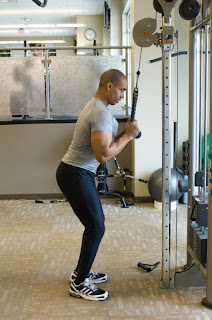
Exercise # 6 - Cable Triceps
Press


The triceps press strengthens and
develops your triceps - muscles in the back of your arms. Find the rope that has a ball on each end,
and attach it to the cable machine a little above your head. Step back about a foot from the rope,
position your feet shoulder width apart, and bend your knees slightly. Grasp the rope tightly with your hands
resting on the balls. Bend your elbows
to where your forearms are just above parallel to the floor and lift your up
chest. This is your start position. Slowly press your hands down until your arms
are fully extended and then slowly return to the start position. To get the full effect of this exercise, it
is very important to keep your elbows still at your sides throughout the
movement. Breathing pattern is to exhale
as you press down and inhale as you return to start.
Do 1 warm-up set of 12 repetitions at 50% of your exercising resistance.
(Your exercise resistance is a weight with which the last 3 repetitions
are hard to complete with proper form). Rest 60 seconds and then do 2
more sets of 8 to 12 repetitions at your exercising resistance (resting
60 seconds between sets)
Exercise # 5 - Calf Raises
Calf raises strengthen your calves
and help keep your Achilles tendons healthy.
First, stand on the machine and adjust the shoulder pad to a position
where the weight comes about six inches off the stack when you are standing
straight. Next, step onto the platform
with the ball of your feet, and stand-up straight. (Do not lock your
legs). This is your start position. Slowly lower your heels down as far as
possible, and then come up on your toes as far as possible. Your breathing pattern is to exhale as you
are lifting up and inhale as you are going down.
Do 1 warm-up set of 12 repetitions at 50% of your exercising resistance.
(Your exercise resistance is a weight with which the last 3 repetitions
are hard to complete with proper form). Rest 60 seconds and then do 2
more sets of 8 to 12 repetitions at your exercising resistance (resting
60 seconds between sets)
Exercise # 7 - Seated Ball Twist


The seated ball twist is a very
good exercise for abdominal development and strength. Sit on the floor with a slight bend in your
legs. Hold a therapeutic ball with your
arms fully extended in front of you.
Lean back slightly, pick your chest up high and pull in your naval. Now, turn your shoulders to one side, and
touch the ball to the floor. Then turn
to the other side, and do the same. A
complete revolution counts as one repetition.
Be sure you arms stay extended throughout this exercise. Breathing pattern is to exhale as you touch
the ball to the floor and inhale as you bring the ball across your body.
Do 3 sets of 15 repetitions.
Strength training is the most effective way of building and maintaining your strength as you age. Please checkout my downloadable strength training programs at Forever Fit and Firm.
Subscribe to:
Posts (Atom)